BambooHR
- 3.8
- Rating
- 1.00M
- Installs
- Free
- Price

 Analysis by App-foxy
HR work rarely becomes difficult because of one dramatic task. It becomes difficult because the same small questions keep returning: Where can I find my employee information? Has my time-off request been seen? What was the latest company announcement? Who needs to approve this? BambooHR is built around reducing that repeated searching. It puts an employee’s everyday HR tasks into a mobile business app instead of making every request depend on a desktop browser, an email thread, or a conversation with the office administrator.
I see it as a companion to an organization’s BambooHR system rather than a complete HR department in a pocket. That distinction matters. The app is most useful when a company already uses BambooHR for its employee records and workflows. In that situation, the phone becomes a practical way to check information, respond to routine tasks, and stay connected while away from a desk. It is free to install, aimed at Everyone, and developed by BambooHR LLC, but its usefulness still depends heavily on how thoroughly an employer has configured the service.
After spending time with it, my overall impression is straightforward: this is a focused tool for removing everyday HR friction, not an app I would choose for general business management. Its strongest quality is convenience. Its main weakness is that the experience can feel limited when a company’s HR process is incomplete, when a task requires deeper context, or when someone expects the mobile app to replace the full web platform.
You May Also Like

 Blood Strike: 2.5 Anniversary
Blood Strike’s Loadouts Turn Every Drop Into a Tactical Gamble
A close look at Blood Strike’s custom loadouts: how fast access to signature weapons reshapes its battle royale rhythm, rewards preparation, and narrows the gap between fights.

 Pandora - Music & Podcasts
Pandora’s Music Is Easy to Start, but Harder to Recover
Pandora’s strength is its low-effort path from a seed to a station. Its weak spot is how much confidence it asks you to place in connection, setup, and quiet recovery.

 8 Ball Pool
 Is Built on Rivalries, Rematches, and Routine
A close look at the rivalries, rematches, shared routines, and unanswered safety questions that turn a quick pool match into a persistent mobile community.

 Samsung Music
’s Quiet Strength Is Playing What You Already Own
Its reach comes less from spectacle than from dependable access to a personal library. That simplicity is both the app’s strongest retention engine and its ceiling.

 AccuWeather: Weather Radar
AccuWeather Review: A Quick, Clear Forecast for Everyday Decisions
For everyday plans, the best forecast is the one you can understand quickly. AccuWeather makes rain timing, radar, and local conditions easy to act on, with a few trade-offs.

 Hill Climb Racing
Why Hill Climb Racing Still Turns Crashes Into One More Run
A tiny car, a bumpy hill and one more upgrade: Hill Climb Racing keeps resurfacing because its simple chaos makes every near-miss feel personal.
More From Our News Desk



Why the small HR tasks add up
The recurring problem BambooHR addresses is the gap between having HR information stored somewhere and being able to reach it at the moment it is needed. An employee may not need a complicated report; they may simply want to check a personal detail, review a request, or handle a routine action before leaving for the day. Without a mobile option, those small jobs often become delayed until the next time a laptop is available.
That delay creates unnecessary work for everyone. Employees send messages for information they should be able to access themselves. Managers spend time answering status questions. HR staff become the human search function for records, forms, and basic requests. A mobile HR app cannot solve poor internal processes, but it can make a well-organized process easier to reach.
This is where the app feels most sensible. It does not try to turn HR into a social network or bury simple actions under a large collection of unrelated business tools. The experience is centered on the employee relationship with the organization. I appreciate that focus because mobile apps are at their best when they shorten a specific path rather than imitate every feature of a desktop system.
The service has also reached a substantial audience: the Android listing shows over a million installs, around fifteen thousand ratings, and an average rating of 4.0. Those figures suggest that it is established enough to be familiar in the small and medium business HR space, while the rating also hints that the experience is useful without being universally smooth. I would not treat the score as a guarantee, but it is a reasonable sign that the app serves a real, recurring need.
Who benefits most from it
I would recommend BambooHR to employees who frequently work away from a desk, managers who need to respond to routine HR actions during a busy day, and small or medium-sized organizations that want a single employee-facing channel. It is especially practical for people who travel between locations, work hybrid schedules, or do not want to open a laptop for every minor HR interaction.
It is less compelling for a person whose employer does not actively use BambooHR. Installing the app alone does not create an employee record or replace an organization’s HR setup. It is also not the right choice for someone looking for payroll software, recruiting tools, accounting, project management, or a broad employee collaboration platform. The category is business, but that does not mean it covers every business task.
Getting to the first useful moment
The first setup should be approached as an access and organization check, not as a long personal customization project. Once the employer has connected an employee to the BambooHR environment, the useful question is whether the information and actions shown in the app match the real workplace process. If a request is missing, a profile detail looks outdated, or an approval route seems unclear, the issue may belong to the company’s configuration rather than the phone application itself.
That is an important distinction for troubleshooting. I would first check whether the employee is using the correct organization access, whether the account is fully activated, and whether the relevant HR workflow has actually been enabled. Reinstalling the app repeatedly is unlikely to fix a missing company process. The mobile interface can expose a workflow, but it cannot invent one that the employer has not configured.
The app supports Android 8.0 and later, which makes it accessible on many still-serviceable phones rather than restricting it to recent hardware. The current version is 4.18.0.1045. In practical terms, I would still keep the operating system and app reasonably current, especially for a business tool that handles personal employment information. A stable login and a maintained device matter more here than visual novelty.
One useful setup habit is to learn which actions are genuinely mobile-friendly and which are better left for the browser. I would use the phone for quick checks and routine responses, then move to the full web experience when a task involves detailed review, extensive information entry, or careful comparison. Treating the app as a fast access point rather than the entire HR workspace makes the experience less frustrating.
A realistic workday example
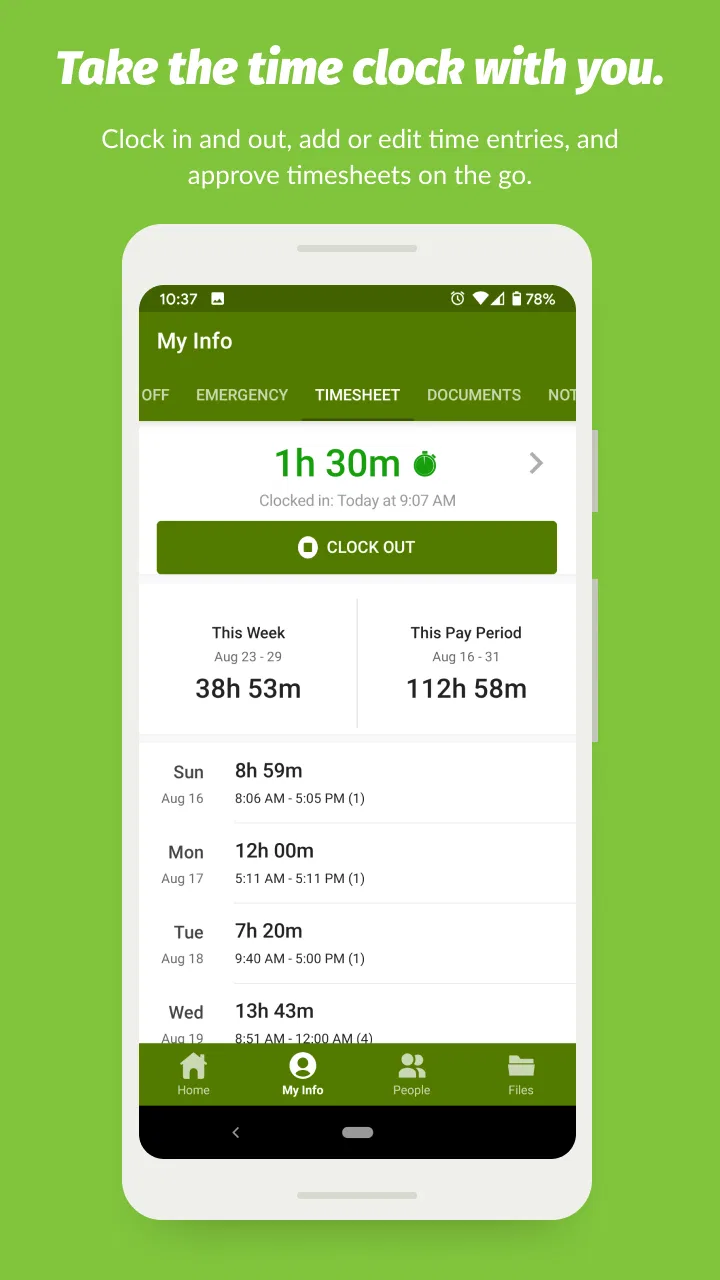
Imagine an employee finishing a shift away from the office and realizing that a planned day off needs attention. Opening a laptop, finding the HR portal, signing in, and locating the relevant area may take longer than the actual request. With BambooHR on the phone, the employee can begin with the mobile workflow instead. The time saved is not dramatic in one instance, but the repeated reduction in small steps is exactly where the app earns its place.
Another scenario involves a manager moving between meetings. A routine employee action may be waiting for review, and postponing it until the end of the day can create a backlog. A mobile interface gives the manager a chance to handle the simple item while the context is still fresh. I would not recommend approving anything complex while distracted, but for straightforward actions, removing the need to return to a desk is a meaningful improvement.
The same idea applies to personal information. Employees often need to confirm a detail at an inconvenient moment, perhaps while completing another workplace form or answering a question from a supervisor. A centralized mobile record is more useful than relying on memory or searching old messages. The value is not that the app makes HR exciting; it is that it turns an interruption into a quick lookup.
Where the app removes friction
The biggest gain is less switching. Without a dedicated mobile route, an employee may jump between email, a browser, downloaded documents, and direct messages with HR. BambooHR gives those employee-facing interactions a more consistent home. That consistency can reduce duplicated questions and make responsibilities clearer: the employee can check the system first, while HR can focus on cases that actually need personal assistance.
There is also a useful accountability benefit. A request handled inside an HR workflow is easier to follow than a request buried in a chat conversation. I am careful not to overstate this: the app does not automatically make an organization responsive. However, placing routine actions in a structured system can make it clearer what has been submitted, what still needs attention, and where a delay may be occurring.
For managers, the trade-off is between speed and context. A phone is excellent for a short action with a clear decision. It is less comfortable when the decision depends on several records, detailed notes, or a long explanation. My practical tip is to use the mobile app as a triage tool: clear the obvious items, flag anything that needs thought, and reserve complicated work for a larger screen. That approach saves time without encouraging rushed decisions.
For employees, a second useful habit is to check the app before contacting HR about routine information. This sounds obvious, but it changes the workflow. Instead of asking someone to retrieve a detail, the employee can verify what is already available and then contact HR with a more precise question if something is wrong. That makes the conversation shorter and more productive.
A third insight is that the app’s value should be judged across a month, not one opening. If a person only uses it once every few weeks, the benefit may be modest. If the organization regularly relies on mobile-friendly HR actions, the accumulated convenience becomes much more noticeable. The right evaluation is not “Does this app do something impressive?” but “How many small trips to a desktop or HR inbox does it remove?”
Compared with the usual alternatives
The most common alternative is a browser-based HR portal. A browser can provide broader access and may be preferable for detailed work, especially on a computer. BambooHR’s advantage is immediacy: the app is easier to reach for a short check or action when a full desktop session would feel excessive. The browser remains the better choice when the task requires space, careful reading, or multiple windows.
Email is another alternative, but it is a poor long-term home for routine HR requests. Email is familiar and flexible, yet messages can be missed, repeated, or separated from the employee record. BambooHR is more structured for the tasks it supports. The trade-off is that email can handle unusual explanations more naturally, while an app works best when the request fits an established workflow.
Some organizations use chat tools for announcements and informal questions. Those tools are faster for conversation, but they are not necessarily a reliable place for personal HR records or approvals. BambooHR has a clearer administrative purpose. I would use chat for quick clarification and the HR app for the official employee-facing action, assuming the employer has set up both roles sensibly.
A spreadsheet or shared document may appear cheaper and simpler for a very small team, but it usually creates its own problems around access, version confusion, and responsibility. BambooHR is a better fit when the organization wants employees and managers to interact with a dedicated HR system rather than maintain a collection of informal files. For a tiny team with almost no recurring HR activity, however, the full platform may feel heavier than necessary.
Limits that affect the recommendation
The first limitation is dependency on the employer. The app cannot be judged like a standalone note-taking or calendar tool because the organization controls much of the experience. If policies are unclear, records are outdated, or approvals are slow, the phone interface will not remove those underlying problems. This is the most important expectation to set before downloading it.
The second limitation is mobile scale. Even a well-designed phone workflow is not ideal for every HR task. Reading a short item is comfortable; reviewing a large amount of employment information or entering detailed material can be tiring. I would not choose the mobile app as my only way to manage HR responsibilities if my role involved frequent administrative work.
The third limitation is that convenience can encourage careless speed. A manager may be tempted to approve a request between other tasks simply because it is available. That is not a flaw unique to BambooHR, but mobile access changes behavior. Organizations should make sure employees understand which actions are routine and which deserve a proper review. The app removes friction; users still need judgment.
There can also be a difference between what an employee expects to see and what the company has decided to expose through its HR setup. That can make the app feel inconsistent from one workplace to another. I would judge it by the quality of the employer’s implementation, not only by the interface. A polished mobile screen cannot compensate for incomplete records or confusing internal policies.
Privacy, access, and everyday trust
Because this is an HR application, I would be more deliberate about device security than I might be with a casual business utility. Use a personal device lock, avoid leaving the app open on a shared phone, and be careful when viewing employment information in public. These are simple habits, but they matter when a single app can provide access to personal workplace details.
I would also clarify the organization’s internal expectations before relying on the app for urgent matters. A mobile request may be submitted quickly, but that does not necessarily mean a manager or HR team will see it immediately. For time-sensitive issues, the normal workplace escalation route still matters. BambooHR can make the request easier to send and track, but it should not be mistaken for an emergency communication channel.
My verdict for employees and employers
BambooHR is a sensible mobile extension for organizations already using BambooHR as their HR system. I like it because it targets a real annoyance: the repeated need to stop what I am doing, find a computer, and navigate a portal for a small employment-related task. Its strongest benefit is not a flashy feature; it is the steady reduction of minor delays and unnecessary messages.
The free price and Everyone age rating make it easy for employees to try, while support for Android 8.0 and later keeps the technical entry point reasonably broad. The product’s scale, with more than a million installs and a 4.0 average from roughly fifteen thousand ratings, supports the view that it is a mature option rather than an experimental side tool. Still, those figures should not replace a practical test inside a specific workplace.
I would recommend it to employees who want quick access to their company’s HR workflows and to small or medium businesses that value a central employee experience. I would skip it as a standalone download if my employer does not use BambooHR, and I would choose the browser or another specialized system when I need deep administration, detailed reporting, or a broader business suite.
My bottom line: BambooHR is worthwhile when it removes a repeated interruption from your workday. It saves the most time for routine, clearly defined HR actions, and it works best when the organization keeps its records and processes well maintained. If that foundation is in place, the app feels like a useful shortcut. If it is not, the mobile convenience cannot hide the underlying friction.
FAQs for BambooHR
01What is BambooHR and what are its primary features?
BambooHR is a cloud-based Human Resources Information System (HRIS) designed for small and medium-sized businesses. Its primary features include employee data management, time-off tracking, performance management, and reporting. It also offers an intuitive interface and mobile app support, making HR tasks easier and more efficient for both managers and employees.
02Is BambooHR suitable for businesses of all sizes?
While BambooHR is primarily designed for small to medium-sized businesses, its scalable features can accommodate growing organizations. It offers various plans that can be tailored to fit the specific needs of different business sizes, making it versatile and adaptable as your company expands.
03How secure is the data stored in BambooHR?
BambooHR employs robust security measures to protect user data, including encryption, regular security audits, and compliance with industry standards like GDPR. They prioritize data privacy and ensure that sensitive information is safeguarded against unauthorized access, making it a secure choice for managing HR data.
04Does BambooHR integrate with other software applications?
Yes, BambooHR offers integrations with a variety of third-party applications, including payroll systems, applicant tracking systems, and performance management tools. This integration capability helps streamline HR processes and ensures seamless operation across different software platforms, enhancing workflow efficiency.
05Is customer support available for BambooHR users?
BambooHR provides customer support through various channels, including email, phone, and live chat. They also offer extensive online resources, such as FAQs, tutorials, and webinars, to assist users in effectively utilizing the platform. Support is generally responsive and helpful in resolving user issues.
Pros
- User-friendly interface for all levels.
- Seamless integration with other tools.
- Automated reminders for tasks.
- Customizable reports and dashboards.
- Mobile app for on-the-go access.
Cons
- Limited customization for small businesses.
- Advanced features can be pricey.
- Occasional syncing issues reported.
- Mobile app lacks some desktop features.
- Customer support response times vary.

BambooHR
Gallery